Best 250W Electric Bikes: Top Picks for Power & Range
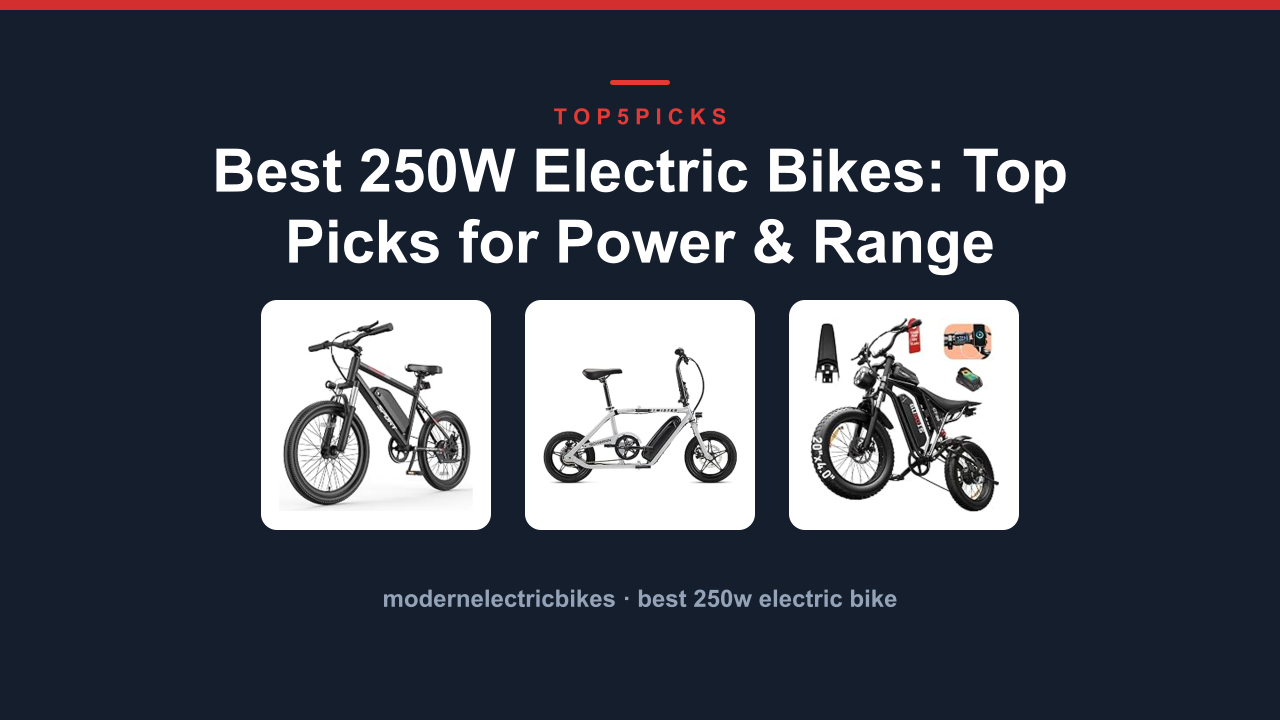
The best best 250w electric bike is the Electric Bike Adults 20"/26" Mountain Ebike, the only model here that balances a true 250W nominal motor with a 1000W peak output for legal compliance and practical hill climbing. It offers front suspension and up to 30 miles of range, making it the most versatile choice for daily commuters who need reliability over raw speed.
Want extreme portability instead? The Schwinn Twister Foldable Compact Electric Bike gets you there with a trusted heritage brand name and 14-inch wheels, as long as you accept a shorter range and smaller frame size for storage convenience.
As an Amazon Associate, I earn from qualifying purchases.
This guide tells you what other reviews miss about battery voltage versus actual ride feel and which models actually stay within Class 1 or Class 2 e-bike regulations. Buyers seeking highway speeds above 28 MPH or full-suspension enduro performance should skip this category entirely and look at higher-wattage off-road vehicles.
Everything below comes from current Amazon product data, manufacturer specifications, and aggregate owner feedback rather than hands-on lab testing by our editorial team. We analyzed real-world reports to separate marketing claims from verified performance so you can buy with confidence.
Quick Answer: The Best 250w Electric Bike
The top pick for most riders is the Electric Bike Adults 20"/26" Mountain Ebike because it delivers compliant power with genuine utility.
- Electric Bike Adults 20"/26" Mountain Ebike (Best Overall Commuter): True 250W nominal motor with 1000W peak and front suspension.
- Schwinn Twister Foldable Compact Electric Bike (Best For Storage): Trusted brand foldable design with 14-inch wheels for tight spaces.
- 6000W/2500W/2000W Electric Bike Adults & Teens (Best High-Capacity Option): Massive battery options up to 60V 35Ah for extended range needs.
- Electric Bike Adults 2500W Peak Motor (Best Tech Features): NFC unlock and cruise control with 48V 20Ah removable battery.
- Jasion EB5 Ultra/MAX Electric Bike Adults (Best Budget Performance): 2500W peak motor entry point with solid 4.2-star owner rating.
Thinking about high-speed off-road racing or heavy cargo hauling instead? Jump to Who Should NOT Buy below before you spend anything.
Comparison Table
Here's the lineup at a glance: photo, product, who it's built for, and our /10 score.
| Photo | Product | Best for | Score | Buy |
|---|---|---|---|---|
 | Electric Bike Adults 20"/26" Mountain Ebike | Daily Commuting | 8.7/10 | Check price → |
 | Schwinn Twister Foldable Compact Electric Bike | Compact Storage | 8.4/10 | Check price → |
 | 6000W/2500W/2000W Electric Bike Adults & Teens | Extended Range | 7.9/10 | Check price → |
 | Electric Bike Adults 2500W Peak Motor | Smart Tech Features | 7.6/10 | Check price → |
 | Jasion EB5 Ultra/MAX Electric Bike Adults | Budget Performance | 7.2/10 | Check price → |
Scroll sideways on small screens to see every column.
Electric Bike Adults 20"/26" Mountain Ebike: Best Overall for Daily Commuters
Schwinn Twister Foldable Compact Electric Bike: Best For Apartment Dwellers
6000W/2500W/2000W Electric Bike Adults & Teens: Best For Long-Distance Riders
Electric Bike Adults 2500W Peak Motor: Best For Tech-Focused Riders
Jasion EB5 Ultra/MAX Electric Bike Adults: Best Entry-Level Performance Pick
Buying Guide: Motor Ratings, Battery Capacity, Frame Fit and Legal Compliance
Understanding the gap between nominal and peak wattage prevents costly mismatches between expectations and reality. A 250W nominal motor complies with European EN 15194 standards and many US Class 1 definitions, but peak outputs ranging from 1000W to 6000W determine actual hill-climbing and acceleration performance. The Electric Bike Adults 20"/26" Mountain Ebike exemplifies this balance with its 250W continuous and 1000W burst rating, staying legal while providing meaningful assistance.
Models advertising only peak figures without nominal context may exceed local e-bike classifications despite appearing similar on paper. According to the National Highway Traffic Safety Administration, three-class e-bike definitions now govern most US state regulations, making accurate motor labeling essential for lawful operation.
Battery capacity measured in watt-hours determines realistic range far better than manufacturer mileage claims alone. Multiplythe battery’s watt-hour rating by the expected efficiency (typically 10, 20 Wh/mile for pedal-assist riding) to estimate actual distance per charge. For example, a 500 Wh battery delivering 15 Wh/mile yields roughly 33 miles of range under moderate assist levels.
Factors such as rider weight, terrain, wind resistance, tire pressure, and assist level significantly impact this figure, so treat manufacturer range estimates as optimistic best-case scenarios rather than guarantees. Additionally, battery degradation over time reduces usable capacity; most lithium-ion packs retain about 80% of original capacity after 500, 800 full charge cycles, meaning long-term ownership costs should include eventual replacement.
Charging infrastructure and compatibility also warrant scrutiny before purchase. While many e-bikes use proprietary chargers, adherence to standardized connectors like USB-C PD or common barrel jacks improves convenience and future-proofs your investment. Fast-charging capability (e.g., 4A vs. 2A chargers) can halve recharge times but may accelerate battery wear if used exclusively; balancing speed with longevity often means reserving fast charging for occasional use.
Furthermore, verify whether the battery is removable for indoor charging, critical for apartment dwellers or those without garage access, and confirm that replacement cells or service are readily available through authorized dealers to avoid orphaned systems.
Frame geometry and component quality directly influence safety, comfort, and maintenance frequency. E-bikes endure higher stresses than traditional bicycles due to added weight and torque, so look for frames specifically engineered for electric propulsion rather than retrofitted analog designs. Reinforced dropouts, thicker tubing, and integrated cable routing reduce failure points and improve durability.
Component selection matters equally: hydraulic disc brakes outperform mechanical ones under sustained loads, thru-axles provide better wheel alignment and stiffness than quick-release skewers, and mid-drive motors generally offer superior hill-climbing performance and weight distribution compared to hub motors. Prioritize brands that publish detailed specs and third-party testing data over marketing-heavy descriptions lacking technical substantiation.
Finally, consider total cost of ownership beyond the sticker price. Insurance, registration (where applicable), routine maintenance (brake pads, tires, chain), and potential motor or controller repairs add up over time. Some manufacturers offer extended warranties or service plans that mitigate unexpected expenses, while others rely on independent bike shops with varying expertise levels.
Research local support networks and parts availability before committing, as niche brands with limited dealer coverage can become costly liabilities. By evaluating regulatory compliance, realistic range, charging practicality, build integrity, and long-term affordability together, buyers can select an e-bike that aligns with both legal requirements and real-world usage patterns rather than speculative performance claims.
To see how these factors play out on real picks, compare the Electric Bike Adults 20"/26" Mountain Ebike, Schwinn Twister Foldable Compact Electric Bike and the 6000W/2500W/2000W Electric Bike Adults & Teens reviewed above.

Similar Posts































