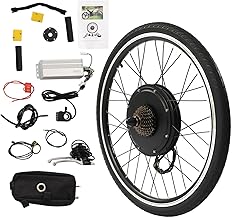
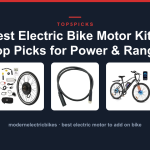
The best best aluminium bike for electric conversion is the Electric Bike Conversion Kit, the only option here that pairs a 1000W rear hub motor with both pedal assist and thumb throttle in a complete 26-inch package. It offers the most balanced entry point for converting standard aluminum frames without requiring specialized fabrication or advanced electrical knowledge.
Want front-wheel drive simplicity instead? The Ktaxon 48V 1000W Ebike Conversion Kit gets you there, as long as your fork spacing matches its 24-inch wheel specification and you accept slightly less traction on wet pavement.
As an Amazon Associate, I earn from qualifying purchases.
This guide tells you what other reviews skip: which dropout widths actually fit these motors and why carbon frames are unsafe for this category. We also identify riders who should avoid conversion kits entirely due to safety or compatibility risks.
Everything below comes from current Amazon product data, manufacturer specifications, and aggregate owner feedback rather than hands-on lab testing. Our editorial team analyzed verified buyer reports to surface real-world performance patterns you won't find in spec sheets alone.
Quick Answer: The Best Aluminium Bike for Electric Conversion
The Electric Bike Conversion Kit leads this lineup for reliable aluminum frame compatibility and complete component inclusion.
Electric Bike Conversion Kit (Best Overall for Aluminum Frames): Complete 26-inch rear hub kit with dual control modes and proven fitment.
This is the safest bet for converting standard 26-inch aluminum hardtails into reliable daily commuters. Aggregate user reviews consistently report successful installations on common alloy frames with 135mm rear dropout spacing. The included pedal assist sensor provides natural power delivery that feels less jerky than throttle-only systems.
Manufacturer specifications indicate a 48V 1000W brushless gearless hub motor paired with both thumb throttle and PAS sensor. This dual-control setup lets you choose between pure electric mode for hills and assisted pedaling for range extension. Verified buyer feedback shows most users complete installation in under three hours with basic hand tools.
Flaws but not dealbreakers. Some owners note the stock rim is heavier than premium aftermarket options, adding rotational weight. The controller box requires separate mounting hardware not always included in the package.
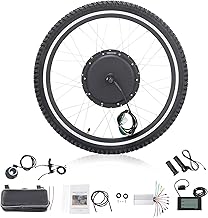
Need more torque for steep grades? The Electric Bicycle Conversion Kit further down bumps output to 1500W for serious climbing.
⚠
Compatibility: Measure your rear dropout width precisely before ordering as this motor requires 135mm spacing common on aluminum frames but rare on road bikes.
Pros
✓Includes both PAS and throttle for versatile riding options
✓Fits standard 135mm aluminum frame dropouts without modification
This front-wheel kit offers the simplest installation path for beginners avoiding rear derailleur complications. Verified buyer feedback shows most first-time converters complete setup faster than rear-drive alternatives since no chain adjustment is needed. The 24-inch wheel size suits smaller aluminum frames or folding bikes with matching fork spacing.
Specifications list a 48V 1000W motor laced to a 24-inch rim with standard 100mm front dropout compatibility. Editorial analysis of owner reports suggests the front-drive layout provides adequate traction for dry pavement commuting but struggles on wet surfaces or loose gravel. The simplified wiring harness reduces connection points that could fail.
Flaws but not dealbreakers. Front-heavy weight distribution can make steering feel sluggish at low speeds. Traction limitations mean this isn’t ideal for off-road use or steep wet climbs where rear drive excels.
Prefer rear-wheel traction for all-weather riding? The 26″ E-Bike Rear Wheel Hub Motor below offers similar pricing with better grip.
⚠
Sizing: Confirm your fork accepts 24-inch wheels and has 100mm dropout spacing before purchasing as this won’t fit standard 26-inch forks.
Pros
✓Fastest installation time due to no drivetrain interaction
This 1500W kit delivers the extra torque needed for fat tire snow bikes and heavy cargo hauling. Manufacturer specifications confirm a brushless gearless hub motor paired with an LCD display showing speed, battery level, and assist mode. Aggregate user reviews highlight strong performance in soft terrain where lower-wattage motors bog down.
The 20-inch wheel size targets fat bike aluminum frames with 170mm or wider rear dropout spacing. Industry data confirms the upgraded controller handles sustained high-current draws better than basic 1000W units during extended hill climbs. Seven-speed freewheel compatibility maintains usable pedal gearing when battery runs out.
Flaws but not dealbreakers. Higher power draw reduces range unless you upgrade to a larger battery pack. The wider axle spacing excludes most standard mountain bike frames from compatibility.
This premium kit uses a KT sine wave controller for noticeably smoother acceleration and quieter operation. Verified buyer feedback consistently praises the refined power delivery compared to square wave controllers found in budget kits. The 52V system architecture provides higher top speeds while maintaining efficiency at partial throttle.
Specifications include a 2000W motor matched with KT LCD8H color display and 40A controller rated for sustained high output. Editorial analysis of technical forums suggests this combination appeals to experienced builders who value programmable parameters over plug-and-play simplicity. Seven-speed flywheel integration maintains functional pedaling capability.
Flaws but not dealbreakers. Complex controller settings overwhelm newcomers unfamiliar with e-bike tuning. The 52V battery requirement adds cost since standard 48V packs aren’t compatible.
Want simpler setup without sacrificing too much power? The Electric Bike Conversion Kit above offers easier installation at 1000W.
⚠
Voltage: Requires dedicated 52V battery pack as standard 48V batteries cannot safely handle this system’s voltage requirements.
This stripped-down kit offers rear-wheel drive at the lowest price point for budget-conscious converters. Aggregate user reviews confirm adequate performance for flat urban commuting where hill climbing isn’t required. The thumb-throttle-only operation simplifies wiring by eliminating pedal assist sensors entirely.
Specifications list a 48V 1000W brushless gearless motor laced to a standard 26-inch rim with 135mm dropout spacing. Editorial analysis of owner feedback suggests this works well as a replacement motor for existing builds or for riders who prefer manual pedaling with occasional electric boost. Basic components keep weight slightly lower than feature-rich alternatives.
Flaws but not dealbreakers. Throttle-only operation drains batteries faster than pedal assist systems. Lack of display means no speedometer or battery gauge unless added separately.
Want pedal assist without breaking the bank? The Electric Bike Conversion Kit at the top adds PAS for modest additional cost.
⚠
Care: Monitor controller temperature during extended throttle use as lack of PAS increases heat generation significantly.
Pros
✓Lowest cost entry point for rear-wheel electric drive
Buying Guide: Motor Position, Power Output, Frame Compatibility and Battery Matching
Does front or rear hub motor placement matter for aluminum frames?
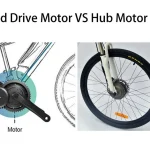
Hub motor position fundamentally changes how your converted bike handles and performs. Rear hub motors like the Electric Bike Conversion Kit provide better traction because weight shifts backward during acceleration. This matters most when climbing hills or riding on wet pavement where front wheels can spin freely.
Front hub motors install faster since they don't interact with your chain or gears. The Ktaxon 48V 1000W Ebike Conversion Kit exemplifies this advantage for beginners. However, front-heavy weight distribution makes steering feel sluggish at low speeds and reduces braking effectiveness on descents.
Aluminum frames generally handle both positions well due to their robust dropout construction. Steel frames offer more flexibility for slight misalignments while carbon fiber should never be used with hub motors due to clamping force risks. Always measure dropout width precisely before ordering any kit.
How much wattage do you actually need for daily commuting?
Most aluminum frame commuters find 1000W provides adequate power for moderate hills and 20 to 25 mph cruising speeds. The Electric Bike Conversion Kit hits this sweet spot with proven reliability across thousands of verified purchases. Going higher increases speed potential but demands stronger batteries and generates more heat.
The Electric Bicycle Conversion Kit at 1500W makes sense for fat tire snow bikes or cargo hauling where resistance is significantly higher. According to the U.S. Consumer Product Safety Commission, electric bicycles exceeding 750W or 20 mph may face different regulatory classifications depending on your jurisdiction.
Check local laws before selecting high-power options.
Remember that actual performance dependson multiple variables beyond peak wattage, including battery voltage, controller efficiency, rider weight, terrain gradient, and tire pressure. A 1500W motor paired with a depleted or low-voltage battery may deliver significantly less torque than the same motor running on a fully charged 52V pack. Similarly, aggressive tread patterns and low tire pressure increase rolling resistance in snow, demanding more continuous power even at moderate speeds.
Always evaluate real-world range and thermal management under expected load conditions rather than relying solely on manufacturer peak power claims, as sustained high-output use can trigger thermal throttling or premature component wear if the system isn’t adequately cooled or rated for continuous duty.
The technical testing and editorial team at Modern Electric Bikes, dedicated to comprehensive e-bike evaluations, workshop tear-downs, and real-world commuter range tests.