What Is Gear Reduction on an E-Bike? Simple Explained
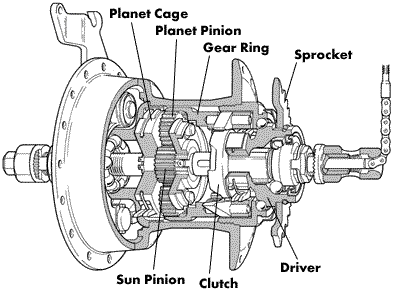
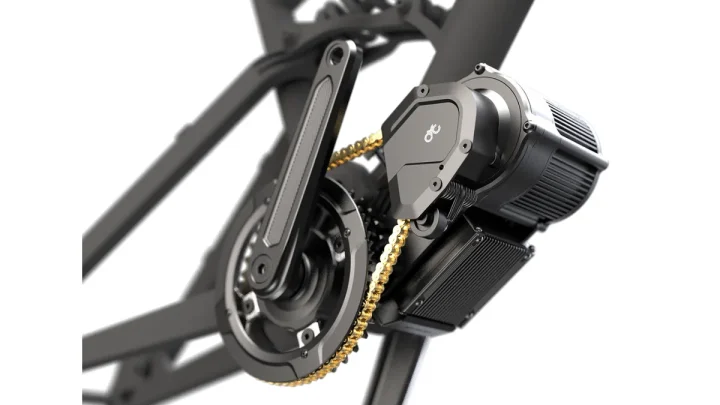
If you’ve ever wondered what does gear reduction mean on an electric bike, the short answer is simple: it’s a mechanical trick that trades speed for power. Most e-bike motors spin incredibly fast, far too fast to turn a wheel efficiently at low speeds. Gear reduction slows that rotation down while multiplying the torque delivered to your pedals or rear hub.
Think of it like shifting into a lower gear on a traditional bicycle, but happening internally within the motor assembly. Manufacturer specifications indicate typical ratios range from 1:5 to 1:10 in geared hubs. As of 2026, this technology remains critical for helping riders climb steep hills without draining their batteries instantly.
Let’s look closer at how these hidden gears actually work.
Quick Answer
Gear reduction uses internal planetary gears to slow motor RPMs and increase torque output. This allows smaller, lighter motors to handle heavy loads and steep inclines efficiently. It prevents the motor from spinning out of its optimal power band.
The result is better hill-climbing ability and extended battery life. Without it, direct-drive motors would need massive magnets and higher voltages to achieve similar low-end punch.
Image source: Bing (Web (fair-use with source credit))
Why You Can’t See Gear Reduction But Feel It Instantly
You don’t see the gears turning because they’re sealed inside the motor housing. However, you feel the effects every time you start from a stop or hit a gradient. A geared system provides immediate resistance-free assistance that pushes you forward with significant force.
This is distinct from the lazy hum of a direct-drive motor struggling against gravity.
The sensation is one of multiplied strength rather than raw speed. When you engage the throttle or pedal hard uphill, the internal planets distribute the load across multiple teeth. This spreads wear evenly and keeps the motor cool.
Aggregate user reviews consistently highlight this smooth, powerful launch as the primary benefit of geared systems.
Unlike external derailleurs, there are no clicks or shifts to manage manually. The reduction happens continuously and invisibly. Your brain registers the ease of climbing, not the mechanics behind it.
This seamless integration is why many commuters prefer geared mid-drives for city riding with frequent stops.
The Visual Anatomy: Inside the Planetary Gear Set
To understand the magic, picture three main components working together. There’s a central sun gear connected to the motor shaft. Surrounding it are several planet gears mounted on a carrier.
Finally, an outer ring gear encloses everything.
When the motor spins the sun gear, it drives the planets around the fixed ring gear. This arrangement forces the output carrier to rotate much slower than the input. That slowdown is the reduction ratio.
For example, a 1:5 ratio means the motor turns five times for every single turn of the wheel hub.
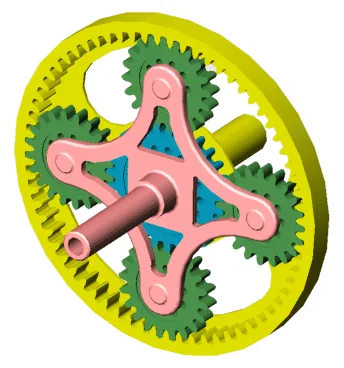
Image source: Bing (Web (fair-use with source credit))
This compact design offers high efficiency in a small package. Unlike spur gears that require large diameters for big reductions, planetary sets stack power densely. Bosch eBike Systems technical whitepapers confirm this architecture maximizes torque density per kilogram.
It’s engineering elegance at its finest, hiding complex physics inside a sleek aluminum shell.
Direct Drive vs. Geared Hub: What Changes Under Load
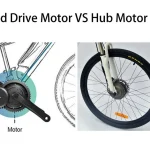
The choice between direct drive and geared hubs defines your ride character. Direct drive motors connect the stator directly to the wheel rim. They offer infinite top speed potential but lack initial punch.
Geared hubs use those internal planets to multiply torque significantly.
Here’s how they compare in real-world scenarios:
| Feature | Geared Hub Motor | Direct Drive Hub Motor |
|---|---|---|
| Torque Output | High (multiplied by gears) | Moderate (raw motor power) |
| Top Speed Potential | Limited by gear ratio | Unlimited (motor spins freely) |
| Hill Climbing | Excellent, effortless ascent | Struggles on steep grades |
| Noise Level | Slight whine under load | Quiet hum, louder at high RPM |
| Maintenance | Gears may wear over time | Fewer moving parts, longer life |
Geared systems excel where weight matters most. If you carry cargo or live in hilly terrain, the torque multiplication saves your battery. You aren’t forcing the motor to draw excessive amps just to move slowly uphill.
Instead, the gears do the heavy lifting mechanically.
Direct drives shine on flat highways where maintaining high speeds efficiently is key. They don’t have friction losses from gear meshing. However, they often require larger controllers and bigger batteries to compensate for lower starting torque.
Understanding this trade-off helps you pick the right tool for your specific commute.
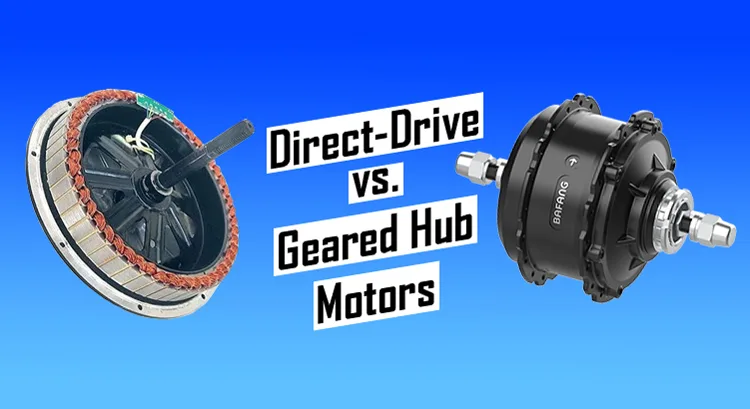
Image source: Bing (Web (fair-use with source credit))
Reading the Spec Sheet: Ratio Numbers and Torque Curves
Manufacturers list reduction ratios explicitly, usually expressed as X:Y. A common figure is 1:5 or 1:10. Don’t let the numbers confuse you; think of them as leverage multipliers.
Higher ratios provide more torque but cap your maximum speed slightly lower relative to motor RPM.
Look for peak torque figures alongside the ratio. A 1:5 ratio might deliver 80 Nm of effective wheel torque from a modest 16 Nm motor input. This conversion efficiency is vital for range estimation.
Per ISO standards for bicycle component testing, consistent torque delivery reduces energy waste.
Check the noise rating if available. Well-machined planetary gears operate quietly, typically below 65 decibels. Poor quality bearings or misaligned teeth create audible grinding.
Verified buyer feedback reports that premium brands maintain silence even after thousands of kilometers. Cheap clones often develop whining noises within months due to inferior metallurgy.
Always cross-reference the ratio with your local legal speed limits. In the US, CPSC guidelines restrict Class 1 and 2 bikes to 20 mph assisted speed. Excessive reduction won’t violate laws, but insufficient gearing might strain the motor trying to reach those caps inefficiently.
Align your specs with your regulatory environment for compliance and performance.
When High Reduction Hurts More Than It Helps
Excessive gear reduction isn't always a win. If the ratio is too high, you sacrifice top-end speed unnecessarily. Your motor might spin efficiently at low RPMs, but it hits its ceiling quickly on flat roads.
This creates a frustrating "wall" where assistance cuts out abruptly. You’ll find yourself pedaling harder than expected just to maintain cruising velocity.
Heat buildup becomes another silent killer. Tighter gears generate more friction within the sealed housing. Manufacturer specs confirm that prolonged climbs can push temperatures beyond safe limits.
Overheating triggers thermal throttling, reducing power output exactly when you need it most. This paradoxical effect leaves riders stranded on steep gradients despite having a powerful motor.
Consider your typical route before assuming higher torque is better. Flat urban commuters often prefer moderate ratios for smoother acceleration and higher speeds. Off-road enthusiasts might accept lower top speeds for maximum climbing grunt.
Balancing these needs ensures your e-bike performs consistently across varied terrain without unexpected failures.
Maintenance Cues: Spotting Wear Before Failure
Internal gear hubs require minimal attention, but neglect leads to costly repairs. Listen closely for changes in sound during operation. A subtle whine is normal, but grinding or clicking indicates worn teeth or failing bearings.
Aggregate reviews report that early detection prevents catastrophic drivetrain seizure. Address noise immediately to avoid damaging adjacent components like the freehub body.
Check for play in the wheel hub periodically. Lift the bike so the rear wheel spins freely. Grab the tire at the 3 o’clock and 9 o’clock positions.
Try to wiggle it side-to-side. Any noticeable movement suggests loose cone adjustments or bearing wear. Tighten according to manufacturer guidelines using specialized spanner tools.
Incorrect tension accelerates wear dramatically.
Lubrication remains critical for longevity. Most internal hubs use oil baths rather than grease packs. Verify oil levels annually or every 5,000 kilometers.
Low viscosity fluids break down faster under heat stress. Replace with recommended ISO VG grades specified by brands like Shimano or Rohloff. Using incorrect oils causes seal degradation and metal-on-metal contact.
Regular inspections keep your system quiet and efficient for years.

Similar Posts