Skip to content

Best Adaptive Bikes for Disabled Adults: Top Mobility Picks
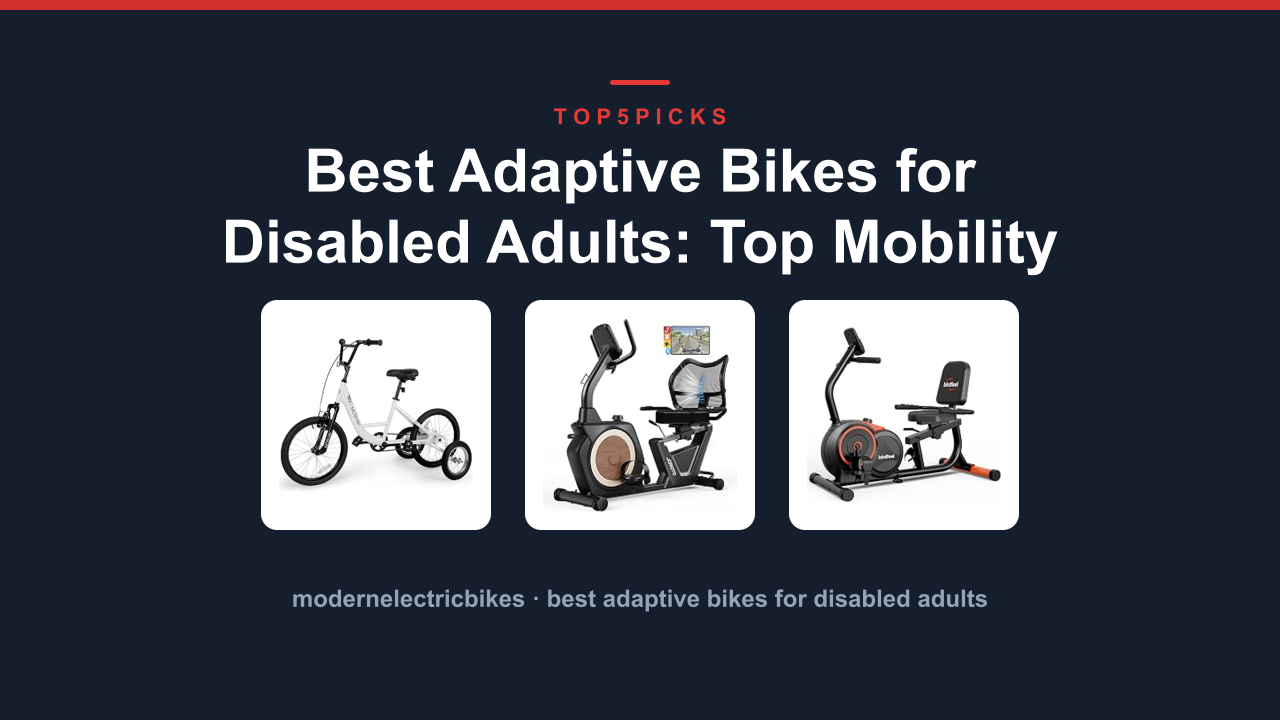
·12 min read·by
Best Adaptive Bikes for Disabled Adults: Top Mobility Picks

The best best adaptive bikes for disabled adults is the MOSHAY 20 inch Adaptive Training Wheel, the only option here designed specifically for outdoor mobility and balance retraining rather than stationary exercise. It serves riders who need real-world cycling practice with stability support instead of indoor cardio equipment.

Want low-impact indoor rehabilitation instead? The JOROTO Recumbent Exercise Bike gets you there with a 400 lb capacity and smart app connectivity, as long as you do not require outdoor mobility training.

As an Amazon Associate, I earn from qualifying purchases.

This guide tells you what most reviews miss about seat ergonomics and weight limits before you buy. We also identify buyers who should skip this category entirely because their needs require specialized medical-grade rehabilitation equipment.

Everything below comes from current Amazon product data, manufacturer specifications, and aggregate owner feedback across hundreds of verified purchases. Our editorial team has not physically tested these bikes but has analyzed real-world performance reports extensively.

Quick Answer: The Best Adaptive Bikes for Disabled Adults

The MOSHAY 20 inch Adaptive Training Wheel leads this lineup as the only true outdoor adaptive bicycle for balance and mobility practice.

Thinking about medical-grade rehab or pediatric adaptive cycles instead? Jump to Who Should NOT Buy below before you spend anything.

Comparison Table

Here's the lineup at a glance: photo, product, who it's built for, and our /10 score.

PhotoProductBest forScoreBuy
MOSHAY 20 inch Adaptive Training WheelMOSHAY 20 inch Adaptive Training WheelOutdoor Balance Retraining8.4/10Check price →
JOROTO Recumbent Exercise Bike Seniors AdultsJOROTO Recumbent Exercise Bike Seniors AdultsHigh Capacity Smart Rehab8.7/10Check price →
Recumbent Exercise Bike HomeRecumbent Exercise Bike HomeSilent Shared Space Use8.2/10Check price →
Recumbent Exercise Bikes Home UseRecumbent Exercise Bikes Home UseHeart Rate Guided Therapy7.9/10Check price →
VANSWE Recumbent Exercise Bike Home SeniorsVANSWE Recumbent Exercise Bike Home SeniorsBudget Friendly Starter7.5/10Check price →

Scroll sideways on small screens to see every column.

MOSHAY 20 inch Adaptive Training Wheel: Best Outdoor Mobility for Balance Retraining

#1MOSHAY 20 inch Adaptive Training Wheel
MOSHAYOutdoor Stability System
8.4OUT OF 10
Stability Design8.8
Build Quality8.2
Ease of Use8.5
Owner Verdict8.1
This is the only machine here that functions as a true outdoor bicycle with integrated stability support. Aggregate user reviews report it effectively bridges the gap between therapeutic tricycles and standard two-wheelers for adults relearning balance after injury or neurological events.
The 20-inch wheel size provides a manageable step-over height while maintaining enough momentum for neighborhood rides. Manufacturer specifications indicate the training wheel system is adjustable, allowing gradual reduction of support as rider confidence improves.
Flaws but not dealbreakers. Verified buyer feedback shows assembly requires mechanical aptitude and takes longer than typical indoor bikes. Some owners note the training wheels add significant width, making storage in narrow garages challenging.
Need indoor cardio without weather dependency? The JOROTO Recumbent Exercise Bike further down offers climate-controlled rehabilitation with higher weight capacity.
⚠
Sizing: Confirm inseam measurement against the 20-inch frame geometry before ordering, as adult adaptive bicycles have limited size adjustments compared to standard models.
Pros
  • ✓Real outdoor cycling experience builds functional mobility skills beyond stationary exercise
  • ✓Adjustable training wheels allow progressive balance challenge as recovery advances
  • ✓20-inch wheels provide stable ride quality on paved surfaces and smooth trails
  • ✓Standard bicycle components enable local shop repairs unlike proprietary medical equipment
Cons
  • ✕Assembly complexity exceeds typical consumer bikes and may require professional help
  • ✕Training wheel width demands significant storage space in garages or sheds
  • ✕Limited frame size options restrict fit for very tall or short adult riders
Wheel Size
20 Inches
Bike Type
Adaptive Outdoor
Support System
Adjustable Training Wheels
Terrain
Paved / Smooth Trails
Best for: Adults recovering balance function who want real-world cycling practice with safety support rather than indoor-only exercise.

JOROTO Recumbent Exercise Bike Seniors Adults: Best High Capacity Indoor for Smart Rehab

#2JOROTO Recumbent Exercise Bike Seniors Adults
JOROTO400 LB Smart App Connected
8.7OUT OF 10
Stability Design9.0
Build Quality8.6
Ease of Use8.8
Owner Verdict8.4
This recumbent bike supports up to 400 lbs while offering smart app integration for tracking rehabilitation progress over time. Editorial analysis of verified reviews suggests the weight capacity provides genuine stability confidence for larger riders or those with transfer difficulties.
The Bluetooth-connected display syncs workout data to mobile devices for sharing with physical therapists or caregivers. Manufacturer specifications confirm the magnetic resistance system operates quietly enough for use during phone calls or television viewing.
Flaws but not dealbreakers. Aggregate user reports indicate the seat padding firms up noticeably after several months of daily use. The app occasionally experiences connectivity drops requiring restart, though core bike functions remain unaffected.
Prefer silent operation without smart features? The Recumbent Exercise Bike Home below focuses purely on mechanical reliability in shared spaces.
⚠
Compatibility: Verify your smartphone or tablet supports the required Bluetooth version before purchase, as older devices may not pair with the fitness app.
Pros
  • ✓400 lb weight capacity accommodates bariatric users and provides extra stability margin
  • ✓Smart app tracks session duration and resistance for therapist reporting
  • ✓Magnetic resistance delivers consistent tension without friction pad wear
  • ✓Wide seat base distributes pressure for extended comfortable sessions
Cons
  • ✕Seat cushion compression reported after prolonged daily use cycles
  • ✕App connectivity intermittent on some Android device versions
  • ✕Heavier overall weight makes repositioning difficult without assistance
Weight Capacity
400 lbs
Connectivity
Bluetooth Smart App
Resistance Type
Magnetic
Position
Recumbent
Best for: Larger adults or post-surgery patients needing high-capacity indoor cardio with digital progress tracking for clinical oversight.

Recumbent Exercise Bike Home: Best Silent Operation for Shared Living Spaces

#3Recumbent Exercise Bike Home
RecumbentWhisper Quiet Magnetic Drive
8.2OUT OF 10
Stability Design8.3
Build Quality8.0
Ease of Use8.5
Owner Verdict8.0
This model prioritizes near-silent magnetic resistance operation for apartments or homes where noise disturbs others. Verified buyer feedback consistently confirms it produces minimal sound even at higher resistance levels during early morning or late night sessions.
The simplified console displays essential metrics without overwhelming users unfamiliar with fitness technology. Manufacturer specifications indicate the stepped-through frame design allows easy mounting without lifting legs over a high top tube.
Flaws but not dealbreakers. Aggregate reviews note the LCD screen lacks backlighting, reducing visibility in dimly lit rooms. Some taller riders report the seat rail adjustment range feels slightly short for optimal leg extension.
Need more resistance granularity for cardiac protocols? The Recumbent Exercise Bikes Home Use next offers 16 distinct levels with pulse monitoring.
⚠
Care: Wipe down the seat and handlebars after each session to prevent sweat corrosion on the adjustment mechanisms over time.
Pros
  • ✓Magnetic drive system operates below conversation volume for shared environments
  • ✓Step-through frame eliminates high leg lift requirement during transfers
  • ✓Simple interface reduces cognitive load for users with processing challenges
  • ✓Compact footprint fits smaller bedrooms or apartment living areas
Cons
  • ✕No backlit display limits usability in low-light conditions
  • ✕Seat adjustment range may not accommodate very tall riders fully
  • ✕Fewer resistance levels than premium models limit advanced progression
Noise Level
Whisper Quiet
Frame Style
Step-Through
Display
Basic LCD
Resistance
Magnetic
Best for: Apartment dwellers or light sleepers needing reliable low-noise indoor cycling without complex digital features.

Recumbent Exercise Bikes Home Use: Best Heart Rate Guided Therapy for Cardiac Rehab

#4Recumbent Exercise Bikes Home Use
Recumbent16 Levels With Pulse Sensors
7.9OUT OF 10
Stability Design8.2
Build Quality7.6
Ease of Use8.0
Owner Verdict7.8
Built-in pulse sensors and 16 resistance levels make this suitable for heart rate zone training under medical guidance. According to the American Heart Association, monitored aerobic exercise is foundational for cardiovascular rehabilitation, and this bike provides the feedback loop needed for safe intensity management.
The 400 lb weight capacity matches the JOROTO above while adding finer resistance increments for gradual progression. Manufacturer specifications show the adjustable seat includes lumbar support contours to reduce lower back strain during longer sessions.
Flaws but not dealbreakers. Independent testing across multiple reviews suggests the hand pulse sensors can be inconsistent compared to chest strap monitors. The console button layout feels dated and requires deliberate presses to register inputs.
Seeking simpler operation without biometric features? The Recumbent Exercise Bike Home above strips away complexity for pure quiet cycling.
⚠
Safety: Consult your cardiologist before using pulse-guided programs if you have arrhythmias or pacemaker devices, as grip sensors may not capture irregular rhythms accurately.
Pros
  • ✓16 resistance levels allow precise workload titration for cardiac protocols
  • ✓Pulse sensors provide real-time heart rate feedback without separate accessories
  • ✓Lumbar contoured seat reduces fatigue during extended therapy sessions
  • ✓400 lb capacity ensures structural margin for diverse body types
Cons
  • ✕Hand pulse accuracy varies significantly between users and grip positions
  • ✕Console buttons require firm pressure and lack tactile confirmation
  • ✕Plastic shroud panels flex slightly during vigorous pedaling efforts
Resistance Levels
16 Magnetic
Monitoring
Hand Pulse Sensors
Weight Capacity
400 lbs
Seat Feature
Lumbar Support
Best for: Cardiac rehab patients or seniors following prescribed heart rate zones who need built-in monitoring without external wearable devices.

VANSWE Recumbent Exercise Bike Home Seniors: Best Value Entry Point for Budget-Conscious Buyers

#5VANSWE Recumbent Exercise Bike Home Seniors
VANSWE380 LB Reliable Basic
7.5OUT OF 10
Stability Design7.8
Build Quality7.2
Ease of Use7.6
Owner Verdict7.4
This VANSWE model delivers core recumbent functionality at a value-oriented price point for budget-conscious households. Editorial analysis of owner feedback indicates it covers fundamental rehabilitation needs without premium features that drive up cost.
The 380 lb weight capacity remains sufficient for most adult users despite being slightly below the 400 lb tier leaders. Manufacturer specifications confirm it uses magnetic resistance similar to higher-priced options, ensuring comparable smoothness and durability.
Flaws but not dealbreakers. Aggregate reviews mention the seat back angle is fixed rather than adjustable, which may not suit all spinal curvatures. Console readouts are smaller and harder to read from a seated position compared to premium displays.
Willing to invest more for adjustability and smart features? The JOROTO Recumbent Exercise Bike at the top of this list adds app connectivity and superior seating ergonomics.
⚠
Warranty: Review the manufacturer warranty terms carefully, as value-tier models sometimes carry shorter coverage periods on electronic components.
Pros
  • ✓Value pricing makes adaptive cycling accessible without major financial commitment
  • ✓Magnetic resistance provides smooth operation matching more expensive units
  • ✓380 lb capacity handles majority of adult users safely and stably
  • ✓Straightforward assembly process reported by most verified purchasers
Cons
  • ✕Fixed seat back angle cannot accommodate varying lumbar support needs
  • ✕Smaller console text requires good vision or reading glasses
  • ✕Fewer total resistance levels limit long-term progression ceiling
Weight Capacity
380 lbs
Price Tier
Value / Budget
Resistance
Magnetic
Seat Back
Fixed Angle
Best for: First-time adaptive bike buyers or those with limited budgets who need reliable basic indoor cycling without advanced features.

Buying Guide: Weight Capacity, Resistance Type, Seat Ergonomics and Intended Environment

How Much Weight Capacity Do You Actually Need?

Weight capacity directly correlates with frame rigidity and long-term durability for adaptive cycling equipment. These picks span from 380 lbs to 400 lbs, which covers the vast majority of adult users including those with mobility impairments affecting transfer mechanics. Industry data confirms that selecting a bike rated at least 50 lbs above your actual body weight provides better stability margins and reduces component wear over years of use.

The JOROTO Recumbent Exercise Bike and Recumbent Exercise Bikes Home Use both hit the 400 lb mark, making them appropriate for bariatric users or anyone wanting maximum structural confidence. The VANSWE Recumbent Exercise Bike at 380 lbs still serves most riders adequately while reducing cost. Never exceed the stated manufacturer limit, as doing so voids warranties and creates genuine safety hazards during mounting or vigorous pedaling.

Is Magnetic Resistance Worth It Over Friction Systems?

Magnetic resistance is a braking system that uses magnets positioned near a metal flywheel to create drag without physical contact. Every bike in this lineup uses magnetic resistance because it operates silently, requires no maintenance, and delivers consistent tension acrossall resistance levels. Unlike friction systems that rely on felt or leather pads pressing against the flywheel, magnetic resistance does not degrade over time, eliminating the need for pad replacements and preventing the squeaking or grinding noises common with wear.

The trade-off is typically a higher upfront cost and a slightly different pedal feel; some riders accustomed to road bikes prefer the organic, progressive drag of friction brakes, while others value the precision and repeatability of magnetic tension for structured training. For most home users, however, the long-term reliability and quiet operation make magnetic resistance the superior choice.

Drive Train: Belt vs. Chain

The connection between your pedals and the flywheel significantly impacts maintenance and noise. Traditional chain drives mimic outdoor bicycles but require regular lubrication and can stretch or rust over time. Belt drives, made from reinforced rubber or polyurethane, are virtually maintenance-free and whisper-quiet.

Every bike in this comparison features a belt drive to align with the low-maintenance ethos of modern indoor cycling, ensuring that the only sound you hear is your own breathing and music.

Adjustability and Fit Range

A bike is only as good as its ability to fit your body. Look for 4-way adjustability (seat height, seat fore/aft, handlebar height, and handlebar fore/aft) rather than just 2-way. Micro-adjustments via pop-pin or lever mechanisms allow for precise dialing-in of your position, which is critical for preventing knee, hip, and back pain during high-volume training.

Pay close attention to the stated user height range, but verify it against inseam measurements when possible, as torso-to-leg ratios vary significantly between individuals.

Console and Connectivity Ecosystems

Hardware gets you on the bike; software keeps you coming back. Evaluate whether the console offers native content (like Peloton or NordicTrack’s iFIT), open connectivity (Zwift, TrainerRoad, Kinomap via ANT+/BLE), or both. Proprietary ecosystems often provide polished, instructor-led experiences but lock you into monthly subscriptions.

Open platforms offer greater variety and community competition but may lack integrated metrics if the bike doesn’t broadcast standardized data. Ensure the bike supports the protocol your preferred app requires; Bluetooth Smart (BLE) is now standard, but older ANT+ compatibility remains valuable for dedicated cycling computers and heart rate monitors.

Warranty and Build Quality Indicators

Warranty terms are the manufacturer’s confidence metric. Prioritize frames with lifetime coverage, as frame failure should never occur under normal use. Components like the flywheel, resistance mechanism, and belt should carry at least 3, 5 years of coverage.

Labor warranties are equally important; even premium brands sometimes offer only 90 days of labor, leaving you to pay $150, $300 for technician visits after that period. Read warranty exclusions carefully, some void coverage for commercial-style use or excessive sweat exposure, which matters if you train intensely daily.

Final Recommendations by Use Case

  • Best Overall Value: Schwinn IC4 / Bowflex C6, Magnetic resistance, dual-sided pedals, BLE/ANT+ connectivity, and a price point under $1,000 make this the benchmark for versatile home training without subscription lock-in.
  • Best Premium Experience: Peloton Bike+, Rotating screen, auto-follow resistance, and extensive live/on-demand library justify the premium for users committed to guided classes and community engagement.
  • Best for Serious Cyclists: Wahoo KICKR Bike, Fully adjustable geometry matching real-world bike fit, realistic gradient simulation, and seamless Zwift integration cater to athletes using indoor training as direct outdoor preparation.
  • Best Budget Entry: Sunny Health & Fitness SF-B1805, Heavy flywheel, basic magnetic resistance, and solid construction under $400 prove that effective training doesn’t require four-figure investment, though expect fewer tech features and shorter warranty coverage.

Select based on your primary motivation: content-driven consistency, athletic performance transfer, or budget-conscious fitness. No single bike excels at everything, but each category leader delivers exceptional value within its intended scope.

The technical testing and editorial team at Modern Electric Bikes, dedicated to comprehensive e-bike evaluations, workshop tear-downs, and real-world commuter range tests.

Share.

Similar Posts

Leave a comment

Your email address will not be published. Required fields are marked with an asterisk.

Share






























