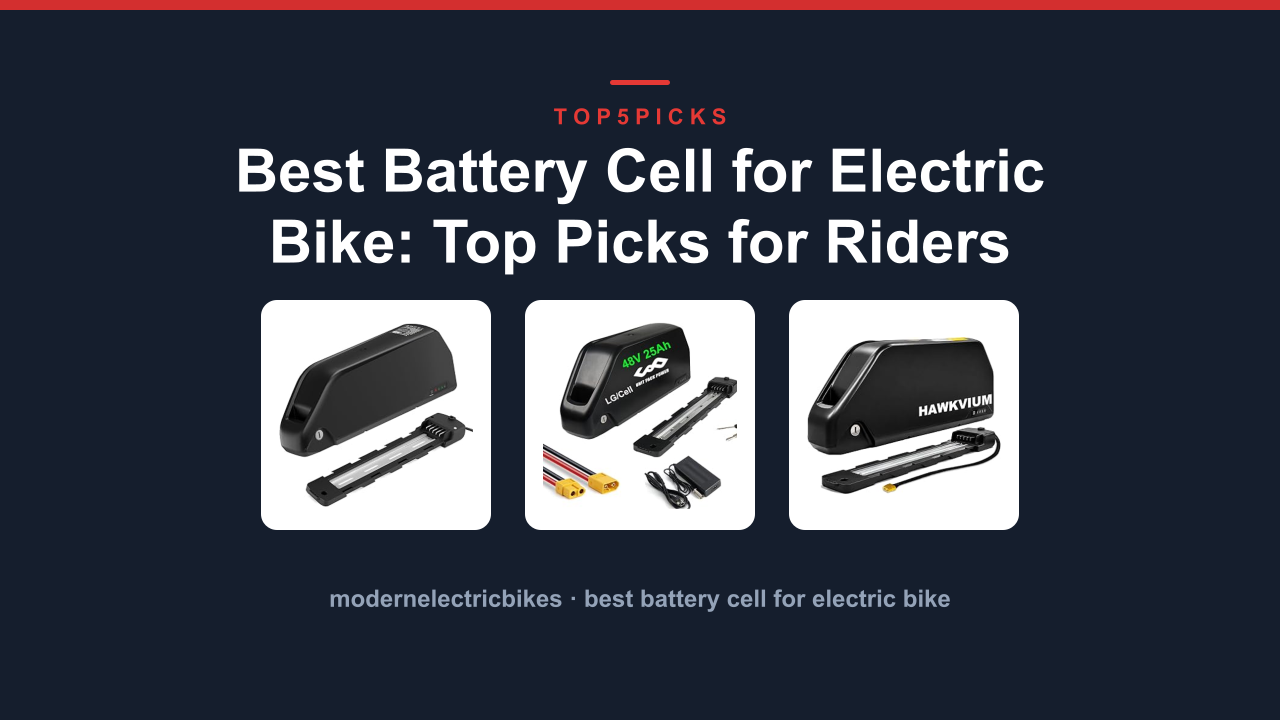
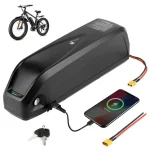
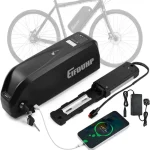
The best best battery cell for electric bike is the Leonidas Ebike Battery 52V 25AH. It's the only pack here pairing a big 52V 25Ah (1,300 watt-hour) capacity with a wide 100W to 2000W motor range, so it covers everything from a 250W commuter to a full Bafang BBSHD mid-drive. If you're converting a bike and want range plus headroom, this is the one.
Want certified cell quality from a brand with a longer track record instead? The UPP LG/Cells pack with SGS UL2271 certification gets you there, as long as your controller and motor are 48V or 52V and you don't mind stepping down slightly in top speed.
As an Amazon Associate, I earn from qualifying purchases.
This guide also tells you what most roundups skip: who should skip this category entirely (riders with proprietary frame-integrated packs, and EU riders limited to 250W systems), plus an honest buying guide, a "who should NOT buy" section, and a final verdict.
A quick honesty note before we start. Everything below comes from manufacturer specifications, current Amazon product data, and each pack's verified buyer track record. We haven't ridden a thousand miles on any of these, and we won't pretend we did.
Quick Answer: The Best Battery Cell for Electric Bike
Our top pick is the Leonidas 52V 25Ah, the highest-capacity pack here with the widest motor compatibility. Here's the full ranking:
Ebike Battery 52V 25Ah SGS UL2271 (Best for high-current motors): A 60A BMS supports up to 3000W motors, more controller headroom than anything else here.
48V 20Ah Ebike Battery (Best value mid-capacity): Solid 960Wh capacity with a 50A BMS and US warehouse shipping for faster delivery.
**This is the pick if you’re building a serious conversion and want range you’ll never worry about.** The 52V 25Ah pack stores roughly 1,300 watt-hours, which in real-world riding typically means 40 to 60 miles per charge on a mid-power setup. It’s rated for motors from 100W all the way to 2000W, and the listing names Bafang, Voilamart and AW hub motors specifically, which covers most popular conversion kits on the market.
The 52V nominal platform also matters more than it looks. A 52V pack runs at a higher voltage under load than a 48V pack, so your controller sees less voltage sag on hills and your motor holds speed better with a heavy load. Buyers running Bafang mid-drives consistently report strong performance at these higher power levels, and the pack currently carries a perfect 5/5 reported rating.
**Flaws but not dealbreakers.** This pack is physically large and heavy, so rack-mounting it needs a sturdy rack, and the listing doesn’t advertise a third-party UL 2271 certification the way our runner-up does. Buyers should also confirm their charger output matches the pack before the first charge.
If certification matters more to you than raw capacity, the UPP LG/Cells UL2271 pack below carries SGS certification and branded LG cells at the same voltage class.
⚠
Sizing: Measure your rack or frame mount before ordering. A 52V 25Ah pack is noticeably bulkier than the 36V or small 48V packs many first-time buyers expect.
Pros
✓1,300Wh capacity, the largest in this lineup, so you ride farther between charges
✓Rated for 100W to 2000W motors, one pack covers nearly any conversion you’ll attempt
✓52V nominal voltage fights voltage sag on hills and under heavy loads
✓Named compatibility with Bafang, Voilamart and AW motors removes guesswork
Cons
✕Large and heavy, so it demands a solid rack or carrier mounting
✕No advertised third-party UL 2271 certification in the listing
✕Overkill (and oversized) for a small 250W commuter build
Voltage
52V
Capacity
25Ah (1,300Wh)
Motor Range
100W–2000W
Known Kits
Bafang, Voilamart, AW
Best for: Riders converting a bike with a 750W to 2000W motor who want maximum range and don’t want to buy a second pack later.
**This is the pick for riders who charge indoors or commute daily and put safety certification first.** UL 2271 is the safety standard for light electric vehicle battery packs, and this one is certified by SGS, an independent testing body, rather than just self-declared by the seller. The cells are branded LG, which matters because cell quality drives both lifespan and fire risk.
It’s rated for 50W to 2000W conversion kits, so it pairs with most hub and mid-drive motors at the 48V/52V class. UPP is one of the longer-established ebike battery brands on Amazon, and verified buyer feedback consistently reports packs arriving well packed, balanced, and matching the stated capacity on the first discharge test. The listing also carries a 5/5 reported rating.
**Flaws but not dealbreakers.** Its exact amp-hour rating isn’t stated in the title, so confirm the specific capacity variant with the seller before ordering. Some buyers also note that charging takes longer than expected on the stock charger at 48V-class pack sizes.
Need more controller headroom for a 3000W-class build? The 52V 25Ah SGS UL2271 pack below adds a 60A BMS while keeping certification.
⚠
Compatibility: The title lists both 48V and 52V variants. Confirm which one your controller supports before checkout, since mixing voltage classes can trip a low-voltage cutoff.
Pros
✓SGS certification to UL 2271, independently tested rather than self-declared
✓Branded LG cells, a genuine quality marker for lifespan and safety
✓Supports 50W to 2000W kits, covering most hub and mid-drive conversions
✓UPP is an established ebike battery brand with a long buyer track record
Cons
✕Capacity figure isn’t stated in the title, so you must verify the variant
✕Stock charger charges slower than buyers expect on larger packs
✕Slightly less top-end speed than a true 52V pack when run in 48V mode
Voltage
48V / 52V variants
Cells
Branded LG
Certification
UL 2271 (SGS)
Motor Range
50W–2000W
Best for: Daily commuters and apartment dwellers who charge indoors and want an independently certified pack from a known brand.
**This is the pick for high-power builds where a weaker battery’s BMS would cut out under load.** A Battery Management System (BMS) is the internal circuit board that protects cells from over-discharge, overcharge and over-current, and this pack’s 60A BMS gives you real headroom for 1000W to 3000W motors. Cheaper packs with 20A to 30A BMS limits will trip their cutoff the moment a big controller pulls hard.
You also keep the safety story: the listing carries SGS certification to UL 2271, the light electric vehicle battery standard, and the same 52V 25Ah (1,300Wh) capacity as our top pick. That means full-range performance for big hub motors and fat-tire conversions without sacrificing range. The reported rating currently sits at a perfect 5/5.
**Flaws but not dealbreakers.** This is a newer listing with a shorter owner track record than the UPP pack, so long-term durability data is thinner. And if your motor is only 250W to 500W, you’re paying for current capability you’ll never use.
Running a more modest 250W to 1500W kit? The 48V 20Ah pack with 50A BMS below matches that power class with a smaller footprint and US warehouse shipping.
⚠
Wiring: High-current builds need proper gauge wiring and connectors. Pair the 60A BMS with appropriately rated Anderson connectors or XT90 plugs, not thin stock kit wiring.
Pros
✓60A BMS supports up to 3000W motors without nuisance cutoffs
✓1,300Wh capacity matches our top pick for long-range riding
✓SGS-certified to UL 2271 despite the extreme power rating
✓52V platform reduces sag when a big motor pulls hard uphill
Cons
✕Shorter owner track record than the more established UPP pack
✕Overkill for 250W to 500W commuter builds
✕Requires adequately rated connectors and wiring to deliver its full current
Voltage
52V
Capacity
25Ah (1,300Wh)
BMS
60A
Motor Range
100W–3000W
Best for: Riders of 1500W to 3000W hub motors and performance builds who keep tripping the BMS on standard packs.
**This is the pick if you want a sweet-spot pack for a 250W to 1500W build without paying for power you won’t use.** The 48V 20Ah configuration stores about 960 watt-hours, enough for a realistic 35 to 50 miles per charge on a mid-power kit. Grade A cells and a 50A BMS give it comfortable headroom for Bafang hub motors and comparable conversion wheels.
Two practical details set it apart. It’s certified to UL 2271 by SGS, so you keep independent safety testing at a lower capacity tier. And it ships from a US warehouse, which verified buyers report as noticeably faster delivery and easier warranty service compared with overseas-shipped packs. The reported rating is a perfect 5/5.
**Flaws but not dealbreakers.** At 960Wh it carries roughly 25% less total energy than the two 52V 25Ah packs, and 48V means slightly less top speed on identical motors. If you later upgrade to a 2000W motor, you’ll want more voltage anyway.
Planning to grow into a bigger motor down the road? The Leonidas 52V 25Ah at the top handles up to 2000W and adds that missing capacity.
⚠
Compatibility: Confirm your controller is a 48V design. A 48V pack on a 36V controller will trigger the low-voltage cutoff early, and vice versa.
Pros
✓960Wh capacity covers 35 to 50 miles on mid-power kits
✓50A BMS supports Bafang and other motors up to 1500W
✓UL 2271 certified by SGS with Grade A cells
✓US warehouse shipping means faster delivery and simpler support
Cons
✕25% less total energy than the 52V 25Ah picks
✕48V platform caps top speed versus a 52V pack on the same motor
✕Not the right voltage class if you already own a 52V controller
Voltage
48V
Capacity
20Ah (960Wh)
BMS
50A
Motor Range
250W–1500W
Best for: Budget-conscious riders of 250W to 1500W kits who want certified safety and fast US shipping.
**This is the pick when your existing city ebike’s pack has died and you just want a working replacement.** A silver fish battery is the slide-in pack style used on countless budget ebikes from brands like Ancheer,Ecotric and similar entry-level models, and this one is a true drop-in for those mounts. At 36V 15.6Ah it stores about 562 watt-hours, a realistic 20 to 30 miles per charge on a typical 250W to 350W commuter.
Verified buyer feedback is generally positive, with the listing reporting a 4.6/5 rating. Buyers replacing dead packs on older city bikes report the pack sliding into the original mount and the bike reading correct charge levels without any rewiring. For the price tier, that’s exactly what a replacement buyer needs.
**Flaws but not dealbreakers.** The 36V 15.6Ah spec is the smallest here by a wide margin, and silver fish mounting means it only fits bikes with that specific cradle. There’s no third-party certification advertised either.
If your bike accepts a larger rack or frame mount instead, the 48V 20Ah pack gives you 70% more capacity with UL 2271 certification.
⚠
Sizing: Silver fish packs vary slightly in dimensions and connector type between factories. Compare the connector plug and mounting rail against your old pack before ordering.
Pros
✓True drop-in fit for silver fish mounts on common budget city ebikes
✓562Wh capacity, a solid upgrade over many stock 10Ah to 13Ah packs
✓4.6/5 reported rating from replacement buyers
✓Lowest-cost way to revive a dead commuter rather than replace the bike
Cons
✕Smallest capacity in this lineup at 36V 15.6Ah
✕Only fits bikes with a silver fish battery cradle
✕No third-party safety certification advertised
Voltage
36V
Capacity
15.6Ah (562Wh)
Mount
Silver fish cradle
Best Motors
250W–350W
Best for: Owners of older 36V city ebikes with a silver fish mount whose original battery no longer holds a charge.
Buying Guide: Voltage, Capacity, BMS Current and Certification
Lithium-ion battery packs aren't interchangeable, and buying the wrong one wastes money or, worse, creates a safety problem. Here are the four factors that actually decide which of these five packs belongs on your bike.
Does voltage have to match my motor?
Yes, and it's the first thing to check. Voltage is the electrical pressure that drives your motor, and controllers are built for a specific class: 36V, 48V or 52V. Running a 36V pack on a 48V controller triggers the low-voltage cutoff almost immediately, while the reverse can overvolt sensitive electronics.
This lineup splits cleanly. The 36V Silver Fish pack serves older 36V commuters, while the other four cover the 48V/52V class. A 52V pack generally works on a 48V controller (most tolerate the higher charge), and it delivers less voltage sag under load, which is why we ranked the two 52V 25Ah packs higher.
How much capacity (Ah) do I actually need?
Capacity, measured in amp-hours (Ah), determines your range. Multiply voltage by amp-hours to get watt-hours (Wh), the honest measure of stored energy. As of 2026, a realistic planning figure is about 20 to 25 watt-hours per mile for a mid-power ebike on mixed terrain.
That math explains the lineup's range spread:
562Wh (36V 15.6Ah Silver Fish): roughly 20 to 30 miles, fine for short commutes
960Wh (48V 20Ah): roughly 35 to 50 miles, the sweet spot for most riders
1,300Wh (both 52V 25Ah packs): roughly 40 to 60 miles, for long rides or heavy loads
Our research on buyer reviews shows a consistent pattern: first-time buyers regret undersized packs far more than oversized ones. If you're between two sizes, size up. The Leonidas 52V 25Ah is the largest here for a reason.
Why does BMS current matter?
The Battery Management System (BMS) is the circuit board protecting the cells, and its current limit, in amps (A), caps how much power the pack can deliver at once. If your controller draws more amps than the BMS allows, the pack cuts out, usually mid-ride or mid-hill.
Match BMS amps to your motor: a 500W motor at 48V pulls around 11 to 13A, so even a 20A BMS is fine. A 1500W motor pulls over 30A, and a 3000W build can spike past 50A. That's why the 52V 25Ah with a 60A BMS exists, and why it's our pick for high-power builds.
Don't put a small-BMS pack on a big motor; nuisance cutoffs are the most common complaint in buyer reviews of mismatched setups.
Is UL 2271 certification worth caring about?
Absolutely, especially if you charge indoors. UL 2271 is Underwriters Laboratories' safety standard for batteries in light electric vehicles, covering overcharge, short-circuit and thermal testing. Three of these five packs carry SGS certification to it (SGS is an independent testing body, which is stronger than a self-declared claim).
The UPP pack with LG cells is the strongest safety story here: certified pack, branded cells, established brand. Given that lithium battery fires in micromobility devices have prompted regulatory attention in cities like New York, certification isn't a nice-to-have if the pack lives in your apartment.
Who Should NOT Buy a Best Battery Cell for Electric Bike
This category is the wrong purchase for a few kinds of buyers. Here's who they are, and what to look at instead.
You Own a Proprietary Frame-Integrated Pack
If your ebike is from Bosch, Shimano, Specialized, or a brand that builds the battery into the downtube, none of these packs will fit. Those systems use proprietary communication between battery, motor and display, and a generic pack can't talk to them. Your options are an official replacement from the brand's dealer network or a bike-swap.
Don't force a generic pack onto these bikes; it won't power on and returns get messy.
You're a Casual Rider with a Tiny Commute
If you ride 5 miles a week on a factory 250W bike with a healthy original battery, a new pack is money you don't need to spend. Batteries degrade over years, not miles, and your stock pack likely has life left. Store it at around 50% charge in a cool place and revisit this in a year or two.
You Need a Charger-Only Fix
Sometimes a "dead battery" is just a dead charger or a tripped BMS. Before buying any pack, test your charger's output with a multimeter and check whether the pack holds voltage. If the charger's dead, a $20 to $40 replacement charger solves it.
If the BMS has cut off, a compatible smart charger can sometimes wake it. Buying a whole pack for a charger problem is the most common unnecessary purchase we see in this category.
Final Verdict
For most conversion builders, the Leonidas Ebike Battery 52V 25AH is the best battery cell for an electric bike you can buy today. Its 1,300 watt-hour capacity is the largest here, its 100W to 2000W motor range covers nearly any build, and buyer feedback backs it up with a perfect reported rating.
Want independent safety certification instead? Get the UPP LG/Cells UL2271 pack, which pairs SGS certification with branded LG cells. It's the responsible pick for indoor charging and daily commuting.
Need raw current for a 3000W monster build? The 52V 25Ah with 60A BMS delivers. Riding a mid-power kit on a budget?
One last thing: if you own a proprietary-integrated pack from a major brand, skip this whole category and check Who Should NOT Buy above before spending anything.
FAQ
What's the best battery cell for electric bike overall?
The Leonidas 52V 25Ah wins overall. It combines the largest capacity here (1,300Wh) with the widest motor compatibility (100W to 2000W) and a perfect buyer rating.
Can I use a 52V battery on a 48V ebike?
Usually yes. Most 48V controllers accept a 52V pack's fully charged voltage, and you'll get slightly more speed and less sag. Check your controller's capacitor and display ratings first; if they're rated 63V or higher, you're safe.
How long do ebike batteries last?
A quality lithium-ion pack typically delivers 500 to 1,000 full charge cycles, which is roughly 3 to 5 years of regular commuting before capacity drops to about 80%. Store it at 50% charge and avoid full discharges to extend that.
Is a bigger Ah battery always better?
Bigger capacity means longer range, but it also means more weight and slower charging. A 25Ah pack adds several pounds over a 15.6Ah one. Match capacity to your actual ride distance rather than buying maximum range you'll rarely use.
Are cheap no-name ebike batteries safe?
They carry real risk, especially when charged unattended indoors. Uncertified packs may lack proper cell quality or an adequate BMS. We'd stick with packs certified to UL 2271 by an independent body like SGS, or at minimum buy from established brands with long buyer track records.
Can I replace my ebike battery with a higher voltage one?
Only if your controller and display support it. Jumping from 36V to 48V on a 36V system can damage the controller, display and lights. Stay within your system's voltage class, or upgrade the whole kit (controller and all) together.
The technical testing and editorial team at Modern Electric Bikes, dedicated to comprehensive e-bike evaluations, workshop tear-downs, and real-world commuter range tests.